🚚 Free Worldwide Shipping on All Orders!Shop Now
1 / 18
+13
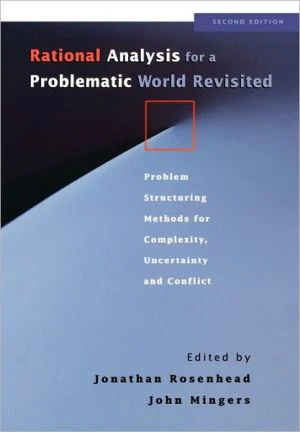
Rational Analysis for a Problematic World Revisited: Problem Structuring Methods for Complexity, Uncertainty and Conflict, 2e
Pages: 386,
Specialty: Management,
Publisher: Wiley,
Publication Year: 2001,
Cover: Paperback,
Dimensions: 168x240x24mm
Now, more than ever, planning and managing in the real world is beset by change and uncertainty. Knowledge is incomplete, values are in dispute, decisions of others are often unpredictable. Sheathed in opaque technicalities, inflexible and over-ambitious, the highly mathematical methods of analysing problem situations are no longer considered acceptable. In their place a coherent alternative paradigm has emerged- a range of formal methodologies which aim not to produce 'optimal' solutions but to facilitate an enriched decision-making process. 'Low-tech' transparent and participatory, these methods assist in the formulation and reformulation of problem solving in an uncertain world. This fully revised and updated book brings together contributions from some of the great thinkers on this subject. The authors present the most influential methods (each illustrated with a case study), describe the principles on which the method operates, the step and the stages of analysis, and how these methods relate to the decision making process. The concluding section explores future developments and research issues, as well as links with other relevant domains. show more
Specialty: Management,
Publisher: Wiley,
Publication Year: 2001,
Cover: Paperback,
Dimensions: 168x240x24mm
Now, more than ever, planning and managing in the real world is beset by change and uncertainty. Knowledge is incomplete, values are in dispute, decisions of others are often unpredictable. Sheathed in opaque technicalities, inflexible and over-ambitious, the highly mathematical methods of analysing problem situations are no longer considered acceptable. In their place a coherent alternative paradigm has emerged- a range of formal methodologies which aim not to produce 'optimal' solutions but to facilitate an enriched decision-making process. 'Low-tech' transparent and participatory, these methods assist in the formulation and reformulation of problem solving in an uncertain world. This fully revised and updated book brings together contributions from some of the great thinkers on this subject. The authors present the most influential methods (each illustrated with a case study), describe the principles on which the method operates, the step and the stages of analysis, and how these methods relate to the decision making process. The concluding section explores future developments and research issues, as well as links with other relevant domains. show more
Pages: 386,
Specialty: Management,
Publisher: Wiley,
Publication Year: 2001,
Cover: Paperback,
Dimensions: 168x240x24mm
Now, more than ever, planning and managing in the real world is beset by change and uncertainty. Knowledge is incomplete, values are in dispute, decisions of others are often unpredictable. Sheathed in opaque technicalities, inflexible and over-ambitious, the highly mathematical methods of analysing problem situations are no longer considered acceptable. In their place a coherent alternative paradigm has emerged- a range of formal methodologies which aim not to produce 'optimal' solutions but to facilitate an enriched decision-making process. 'Low-tech' transparent and participatory, these methods assist in the formulation and reformulation of problem solving in an uncertain world. This fully revised and updated book brings together contributions from some of the great thinkers on this subject. The authors present the most influential methods (each illustrated with a case study), describe the principles on which the method operates, the step and the stages of analysis, and how these methods relate to the decision making process. The concluding section explores future developments and research issues, as well as links with other relevant domains. show more
Specialty: Management,
Publisher: Wiley,
Publication Year: 2001,
Cover: Paperback,
Dimensions: 168x240x24mm
Now, more than ever, planning and managing in the real world is beset by change and uncertainty. Knowledge is incomplete, values are in dispute, decisions of others are often unpredictable. Sheathed in opaque technicalities, inflexible and over-ambitious, the highly mathematical methods of analysing problem situations are no longer considered acceptable. In their place a coherent alternative paradigm has emerged- a range of formal methodologies which aim not to produce 'optimal' solutions but to facilitate an enriched decision-making process. 'Low-tech' transparent and participatory, these methods assist in the formulation and reformulation of problem solving in an uncertain world. This fully revised and updated book brings together contributions from some of the great thinkers on this subject. The authors present the most influential methods (each illustrated with a case study), describe the principles on which the method operates, the step and the stages of analysis, and how these methods relate to the decision making process. The concluding section explores future developments and research issues, as well as links with other relevant domains. show more
$33.07
Original: $94.50
-65%Rational Analysis for a Problematic World Revisited: Problem Structuring Methods for Complexity, Uncertainty and Conflict, 2e—
$94.50
$33.07Description
Pages: 386,
Specialty: Management,
Publisher: Wiley,
Publication Year: 2001,
Cover: Paperback,
Dimensions: 168x240x24mm
Now, more than ever, planning and managing in the real world is beset by change and uncertainty. Knowledge is incomplete, values are in dispute, decisions of others are often unpredictable. Sheathed in opaque technicalities, inflexible and over-ambitious, the highly mathematical methods of analysing problem situations are no longer considered acceptable. In their place a coherent alternative paradigm has emerged- a range of formal methodologies which aim not to produce 'optimal' solutions but to facilitate an enriched decision-making process. 'Low-tech' transparent and participatory, these methods assist in the formulation and reformulation of problem solving in an uncertain world. This fully revised and updated book brings together contributions from some of the great thinkers on this subject. The authors present the most influential methods (each illustrated with a case study), describe the principles on which the method operates, the step and the stages of analysis, and how these methods relate to the decision making process. The concluding section explores future developments and research issues, as well as links with other relevant domains. show more
Specialty: Management,
Publisher: Wiley,
Publication Year: 2001,
Cover: Paperback,
Dimensions: 168x240x24mm
Now, more than ever, planning and managing in the real world is beset by change and uncertainty. Knowledge is incomplete, values are in dispute, decisions of others are often unpredictable. Sheathed in opaque technicalities, inflexible and over-ambitious, the highly mathematical methods of analysing problem situations are no longer considered acceptable. In their place a coherent alternative paradigm has emerged- a range of formal methodologies which aim not to produce 'optimal' solutions but to facilitate an enriched decision-making process. 'Low-tech' transparent and participatory, these methods assist in the formulation and reformulation of problem solving in an uncertain world. This fully revised and updated book brings together contributions from some of the great thinkers on this subject. The authors present the most influential methods (each illustrated with a case study), describe the principles on which the method operates, the step and the stages of analysis, and how these methods relate to the decision making process. The concluding section explores future developments and research issues, as well as links with other relevant domains. show more