🚚 Free Worldwide Shipping on All Orders!Shop Now
1 / 4
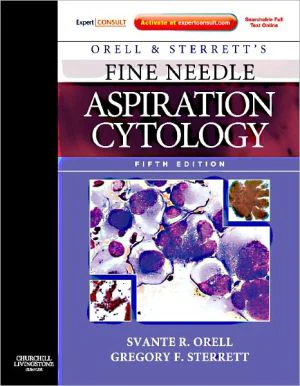
Orell and Sterrett's Fine Needle Aspiration Cytology, 5e
Pages: 512,
Specialty: Pathology,
Publisher: Elsevier,
Publication Year: 2011,
Cover: Mixed media product,
Dimensions: 223.52x281.94x27.94mm
This is a major revision of the leading textbook of FNA cytology. Both text and illustrations provide a systematic and logical approach to the acquisition, interpretation and diagnosis of Fine Needle Aspirate biopsy specimens. "Orell's FNA Cytology" will assist in establishing diagnostic criteria and results in the examination of benign and malignant condition in all body systems where the technique is currently applied. The information is always presented in a clinical context: it details the role of FNA and other ancillary techniques in the investigative sequence (the cytological findings are always set in the context of the patient's clinical history, physical exam and other laboratory tests). It gives practical, technical advice on how to obtain good smears and alerts the reader as to possible diagnostic pitfalls and complications. The contents are organized in a framework of anatomical regions (rather than histopathological classifications) in order to reflect the way problems present in clinical practice. Each chapter is divided into two parts: the first deals with indications, accuracy, techniques and complications; the second illustrates the cytological patterns and their implication. Both common and rare conditions are covered.show more
Specialty: Pathology,
Publisher: Elsevier,
Publication Year: 2011,
Cover: Mixed media product,
Dimensions: 223.52x281.94x27.94mm
This is a major revision of the leading textbook of FNA cytology. Both text and illustrations provide a systematic and logical approach to the acquisition, interpretation and diagnosis of Fine Needle Aspirate biopsy specimens. "Orell's FNA Cytology" will assist in establishing diagnostic criteria and results in the examination of benign and malignant condition in all body systems where the technique is currently applied. The information is always presented in a clinical context: it details the role of FNA and other ancillary techniques in the investigative sequence (the cytological findings are always set in the context of the patient's clinical history, physical exam and other laboratory tests). It gives practical, technical advice on how to obtain good smears and alerts the reader as to possible diagnostic pitfalls and complications. The contents are organized in a framework of anatomical regions (rather than histopathological classifications) in order to reflect the way problems present in clinical practice. Each chapter is divided into two parts: the first deals with indications, accuracy, techniques and complications; the second illustrates the cytological patterns and their implication. Both common and rare conditions are covered.show more
Pages: 512,
Specialty: Pathology,
Publisher: Elsevier,
Publication Year: 2011,
Cover: Mixed media product,
Dimensions: 223.52x281.94x27.94mm
This is a major revision of the leading textbook of FNA cytology. Both text and illustrations provide a systematic and logical approach to the acquisition, interpretation and diagnosis of Fine Needle Aspirate biopsy specimens. "Orell's FNA Cytology" will assist in establishing diagnostic criteria and results in the examination of benign and malignant condition in all body systems where the technique is currently applied. The information is always presented in a clinical context: it details the role of FNA and other ancillary techniques in the investigative sequence (the cytological findings are always set in the context of the patient's clinical history, physical exam and other laboratory tests). It gives practical, technical advice on how to obtain good smears and alerts the reader as to possible diagnostic pitfalls and complications. The contents are organized in a framework of anatomical regions (rather than histopathological classifications) in order to reflect the way problems present in clinical practice. Each chapter is divided into two parts: the first deals with indications, accuracy, techniques and complications; the second illustrates the cytological patterns and their implication. Both common and rare conditions are covered.show more
Specialty: Pathology,
Publisher: Elsevier,
Publication Year: 2011,
Cover: Mixed media product,
Dimensions: 223.52x281.94x27.94mm
This is a major revision of the leading textbook of FNA cytology. Both text and illustrations provide a systematic and logical approach to the acquisition, interpretation and diagnosis of Fine Needle Aspirate biopsy specimens. "Orell's FNA Cytology" will assist in establishing diagnostic criteria and results in the examination of benign and malignant condition in all body systems where the technique is currently applied. The information is always presented in a clinical context: it details the role of FNA and other ancillary techniques in the investigative sequence (the cytological findings are always set in the context of the patient's clinical history, physical exam and other laboratory tests). It gives practical, technical advice on how to obtain good smears and alerts the reader as to possible diagnostic pitfalls and complications. The contents are organized in a framework of anatomical regions (rather than histopathological classifications) in order to reflect the way problems present in clinical practice. Each chapter is divided into two parts: the first deals with indications, accuracy, techniques and complications; the second illustrates the cytological patterns and their implication. Both common and rare conditions are covered.show more
$100.27
Original: $286.50
-65%Orell and Sterrett's Fine Needle Aspiration Cytology, 5e—
$286.50
$100.27Description
Pages: 512,
Specialty: Pathology,
Publisher: Elsevier,
Publication Year: 2011,
Cover: Mixed media product,
Dimensions: 223.52x281.94x27.94mm
This is a major revision of the leading textbook of FNA cytology. Both text and illustrations provide a systematic and logical approach to the acquisition, interpretation and diagnosis of Fine Needle Aspirate biopsy specimens. "Orell's FNA Cytology" will assist in establishing diagnostic criteria and results in the examination of benign and malignant condition in all body systems where the technique is currently applied. The information is always presented in a clinical context: it details the role of FNA and other ancillary techniques in the investigative sequence (the cytological findings are always set in the context of the patient's clinical history, physical exam and other laboratory tests). It gives practical, technical advice on how to obtain good smears and alerts the reader as to possible diagnostic pitfalls and complications. The contents are organized in a framework of anatomical regions (rather than histopathological classifications) in order to reflect the way problems present in clinical practice. Each chapter is divided into two parts: the first deals with indications, accuracy, techniques and complications; the second illustrates the cytological patterns and their implication. Both common and rare conditions are covered.show more
Specialty: Pathology,
Publisher: Elsevier,
Publication Year: 2011,
Cover: Mixed media product,
Dimensions: 223.52x281.94x27.94mm
This is a major revision of the leading textbook of FNA cytology. Both text and illustrations provide a systematic and logical approach to the acquisition, interpretation and diagnosis of Fine Needle Aspirate biopsy specimens. "Orell's FNA Cytology" will assist in establishing diagnostic criteria and results in the examination of benign and malignant condition in all body systems where the technique is currently applied. The information is always presented in a clinical context: it details the role of FNA and other ancillary techniques in the investigative sequence (the cytological findings are always set in the context of the patient's clinical history, physical exam and other laboratory tests). It gives practical, technical advice on how to obtain good smears and alerts the reader as to possible diagnostic pitfalls and complications. The contents are organized in a framework of anatomical regions (rather than histopathological classifications) in order to reflect the way problems present in clinical practice. Each chapter is divided into two parts: the first deals with indications, accuracy, techniques and complications; the second illustrates the cytological patterns and their implication. Both common and rare conditions are covered.show more