🚚 Free Worldwide Shipping on All Orders!Shop Now
1 / 2
Anatomy and Injuries of the Shoulder Anatomical Chart Plastic Styrene
Specialty: Anatomy,
Publisher: Wolters Kluwer,
Publication Year: 2004,
Dimensions: 502x660x501.65mm
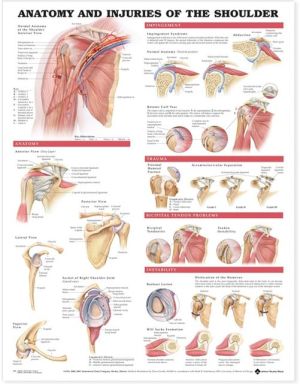
The main image on this chart shows the bones, muscles, ligaments, veins, and arteries of the shoulder. The chart illustrates posterior, lateral, anterior, and superior views of the shoulder anatomy, as well as the socket of a normal shoulder joint. Images show impingement syndrome, rotator cuff tear, trauma (such as proximal humeral fracture and acromioclavicular separation), and bicipital tendon problems. The chart also illustrates instability such as anterior dislocation of the humerus, Bankart lesion, and Hill Sachs formation. show more
Publisher: Wolters Kluwer,
Publication Year: 2004,
Dimensions: 502x660x501.65mm
The main image on this chart shows the bones, muscles, ligaments, veins, and arteries of the shoulder. The chart illustrates posterior, lateral, anterior, and superior views of the shoulder anatomy, as well as the socket of a normal shoulder joint. Images show impingement syndrome, rotator cuff tear, trauma (such as proximal humeral fracture and acromioclavicular separation), and bicipital tendon problems. The chart also illustrates instability such as anterior dislocation of the humerus, Bankart lesion, and Hill Sachs formation. show more
Specialty: Anatomy,
Publisher: Wolters Kluwer,
Publication Year: 2004,
Dimensions: 502x660x501.65mm
The main image on this chart shows the bones, muscles, ligaments, veins, and arteries of the shoulder. The chart illustrates posterior, lateral, anterior, and superior views of the shoulder anatomy, as well as the socket of a normal shoulder joint. Images show impingement syndrome, rotator cuff tear, trauma (such as proximal humeral fracture and acromioclavicular separation), and bicipital tendon problems. The chart also illustrates instability such as anterior dislocation of the humerus, Bankart lesion, and Hill Sachs formation. show more
Publisher: Wolters Kluwer,
Publication Year: 2004,
Dimensions: 502x660x501.65mm
The main image on this chart shows the bones, muscles, ligaments, veins, and arteries of the shoulder. The chart illustrates posterior, lateral, anterior, and superior views of the shoulder anatomy, as well as the socket of a normal shoulder joint. Images show impingement syndrome, rotator cuff tear, trauma (such as proximal humeral fracture and acromioclavicular separation), and bicipital tendon problems. The chart also illustrates instability such as anterior dislocation of the humerus, Bankart lesion, and Hill Sachs formation. show more
$30.00
Anatomy and Injuries of the Shoulder Anatomical Chart Plastic Styrene—
$30.00
Description
Specialty: Anatomy,
Publisher: Wolters Kluwer,
Publication Year: 2004,
Dimensions: 502x660x501.65mm
The main image on this chart shows the bones, muscles, ligaments, veins, and arteries of the shoulder. The chart illustrates posterior, lateral, anterior, and superior views of the shoulder anatomy, as well as the socket of a normal shoulder joint. Images show impingement syndrome, rotator cuff tear, trauma (such as proximal humeral fracture and acromioclavicular separation), and bicipital tendon problems. The chart also illustrates instability such as anterior dislocation of the humerus, Bankart lesion, and Hill Sachs formation. show more
Publisher: Wolters Kluwer,
Publication Year: 2004,
Dimensions: 502x660x501.65mm
The main image on this chart shows the bones, muscles, ligaments, veins, and arteries of the shoulder. The chart illustrates posterior, lateral, anterior, and superior views of the shoulder anatomy, as well as the socket of a normal shoulder joint. Images show impingement syndrome, rotator cuff tear, trauma (such as proximal humeral fracture and acromioclavicular separation), and bicipital tendon problems. The chart also illustrates instability such as anterior dislocation of the humerus, Bankart lesion, and Hill Sachs formation. show more